
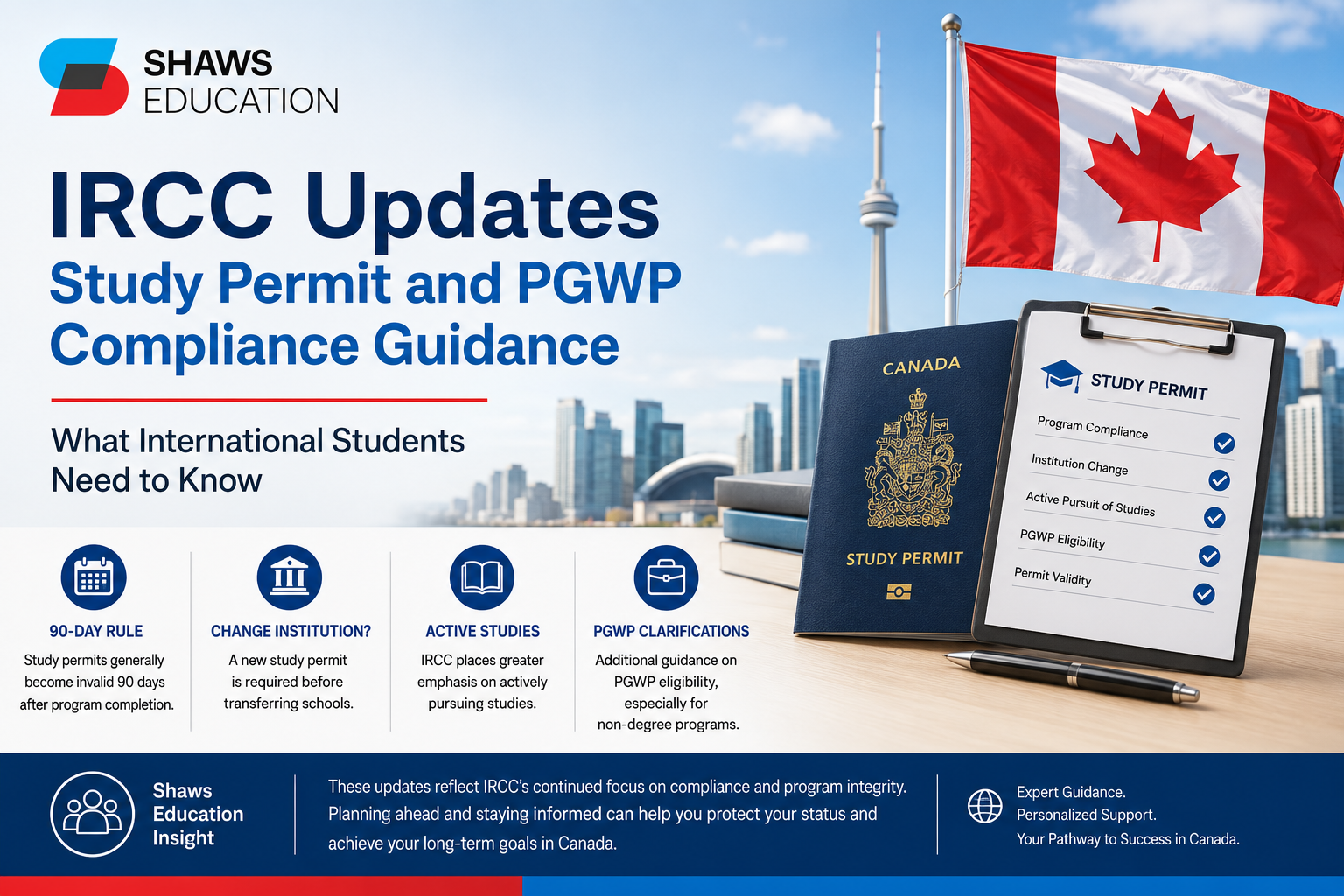
Over the past several weeks, Immigration, Refugees and Citizenship Canada (IRCC) has updated several program delivery instructions related to study permits and Post-Graduation Work Permits (PGWP). While many of these updates clarify existing policies rather than introduce entirely new regulations, they provide important guidance on how IRCC assesses compliance with study permit conditions and PGWP eligibility.
For international students currently studying in Canada—or planning to begin their studies—understanding these updates is essential to maintaining legal status and avoiding unexpected impacts on future immigration plans.
Key Updates
1. Study Permits Generally Become Invalid 90 Days After Program Completion
IRCC has clarified when a student’s studies are considered officially completed. In most cases, completion is determined by the first official notification issued by the Designated Learning Institution (DLI), such as a completion letter, official transcript, or degree confirmation.
Once studies are officially completed, a study permit generally becomes invalid 90 days later, even if the printed expiry date on the permit is later. Students should therefore plan their next steps—such as applying for a PGWP, changing status, or leaving Canada—well before this deadline.
2. Students Changing Institutions Must Obtain a New Study Permit
IRCC has reinforced that students whose study permit specifies a particular Designated Learning Institution (DLI) must apply for a new study permit before transferring to another institution.
Changing schools without obtaining the required authorization may result in the existing study permit becoming invalid, potentially affecting future immigration applications.
3. Greater Emphasis on Actively Pursuing Studies
The updated guidance provides additional detail on IRCC’s expectations regarding “actively pursuing studies.”
Officers may consider factors such as continuous enrolment, academic progression, attendance, and the reasons for any leave of absence when assessing whether a student has complied with study permit conditions.
Students who interrupt their studies or take extended breaks should ensure they understand the applicable IRCC requirements before making decisions.
4. Additional Clarification on PGWP Eligibility
IRCC has also clarified several aspects of Post-Graduation Work Permit eligibility, particularly for graduates of non-degree programs.
Students should verify that their program remains PGWP eligible and understand any applicable field-of-study requirements introduced under recent International Student Program reforms before enrolling or applying for a PGWP.
5. Temporary Exemption for Certain Work Permit Holders Has Ended
The temporary public policy that allowed some work permit holders to study without obtaining a study permit has now ended.
Individuals planning to begin a new academic program should ensure they hold the appropriate immigration authorization before starting their studies.
What These Updates Mean for International Students
Although many of these revisions are clarifications rather than brand-new policies, they reflect IRCC’s increasing focus on compliance throughout a student’s academic journey.
International students should:
- Monitor important dates related to study completion and permit validity.
- Obtain the appropriate authorization before changing institutions.
- Maintain continuous enrolment and satisfactory academic progress whenever possible.
- Confirm PGWP eligibility before selecting a program of study.
- Seek professional advice before making changes that may affect immigration status.
Proactive planning can help students avoid unnecessary delays, refusals, or complications with future work permit or permanent residence applications.
Shaws Education Insight
At Shaws Education, we believe these updates highlight a broader shift in Canada’s international education framework—from simply approving study permits to ensuring ongoing compliance throughout a student’s entire educational pathway.
In recent years, Canada has introduced a series of reforms aimed at strengthening the integrity of the International Student Program. These include new study permit caps, enhanced institutional accountability, updated PGWP eligibility requirements, and clearer expectations regarding student compliance.
For prospective students, choosing a program should no longer be based solely on admission requirements or tuition costs. It is equally important to consider factors such as long-term PGWP eligibility, alignment with labour market priorities, institutional compliance requirements, and future immigration pathways.
Our advisors encourage students to review their study plans carefully before making decisions about changing schools, transferring programs, taking academic leave, or applying for a Post-Graduation Work Permit. Staying informed through official government guidance—and seeking qualified professional advice when needed—can help students make confident decisions and protect their long-term goals in Canada.
Editorial Disclaimer
This article is published by Shaws Education Technologies Inc. for general educational and informational purposes only. While reasonable efforts have been made to ensure the accuracy of the information at the time of publication, policies, labour market conditions, and other information may change without notice. Unless otherwise stated, opinions expressed in the Shaws Education Insight section represent the editorial perspective of Shaws Education and should not be interpreted as legal, immigration, financial, or professional advice. Readers are encouraged to consult official government sources or qualified professionals before making education, career, or immigration decisions.
Sources
- Immigration, Refugees and Citizenship Canada (IRCC)
- ICEF Monitor (industry reporting and policy analysis)