
International students planning to study in Canada should be aware of an upcoming change to the financial requirements for study permit applications.
Immigration, Refugees and Citizenship Canada (IRCC) has updated the minimum amount of funds that study permit applicants must demonstrate to cover their living expenses in Canada. The new amounts will apply to applications submitted on or after September 1, 2026.
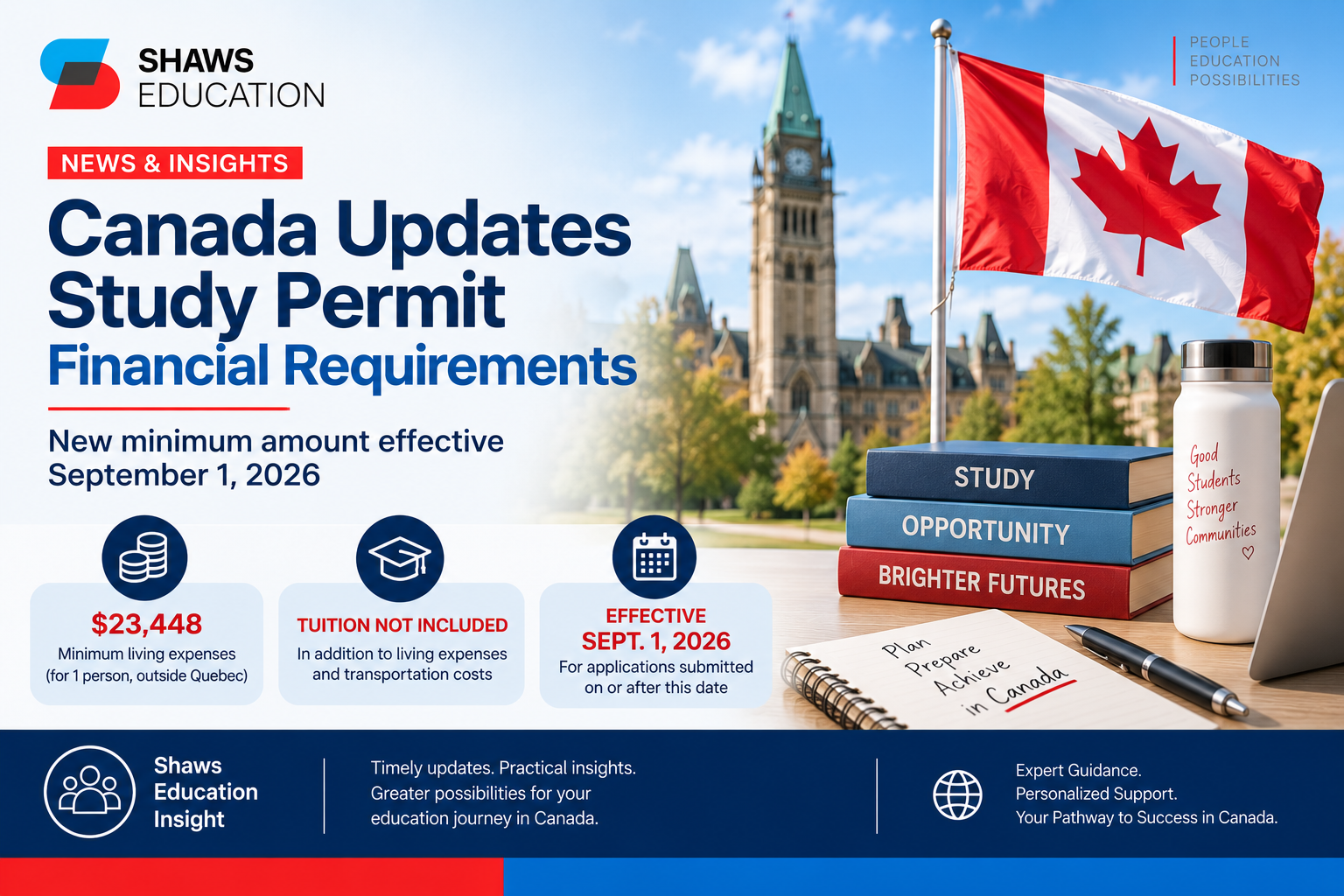
For a single applicant studying outside Quebec, the minimum required amount for first-year living expenses will increase from CAD $22,895 to CAD $23,448. Importantly, this amount is in addition to tuition fees and transportation costs.
Quick Summary
For study permit applications submitted on or after September 1, 2026:
| Family size* | Required living expenses |
|---|---|
| 1 person | CAD $23,448 |
| 2 people | CAD $29,192 |
| 3 people | CAD $35,888 |
| 4 people | CAD $43,572 |
| 5 people | CAD $49,419 |
| 6 people | CAD $55,736 |
| 7 people | CAD $62,054 |
| Each additional person | + CAD $6,318 |
*Family size includes the study permit applicant and accompanying family members. These figures apply to provinces and territories outside Quebec and do not include tuition or transportation costs.
What Is Changing?
Currently, applicants submitting a study permit application between January 1, 2025 and August 31, 2026 must demonstrate at least CAD $22,895 in first-year living expenses for one person outside Quebec.
Beginning September 1, 2026, that requirement will rise to CAD $23,448, an increase of CAD $553 for a single applicant. The required amounts also increase according to the number of accompanying family members.
IRCC updates these financial requirements annually to better reflect changes in the cost of living in Canada. The department has indicated that the financial threshold is tied to Statistics Canada’s Low-Income Cut-Off and is intended to help ensure international students have adequate resources while studying in Canada.
What Do Students Need to Prove?
Meeting the minimum living-expense threshold is only one part of the financial requirement.
According to IRCC, applicants must demonstrate that they have sufficient funds, without relying on employment in Canada, to cover:
- tuition fees;
- living expenses for themselves and any accompanying family members; and
- transportation to and from Canada.
Students must demonstrate sufficient financial resources for the first year of study. If the program is longer than one year, applicants must also explain how they plan to finance the full duration of their studies. IRCC assesses both the amount of available funds and their source.
What Can Be Used as Proof of Financial Support?
IRCC provides several examples of documents that may be used to demonstrate financial capacity, including:
- proof of first-year tuition and housing payments;
- student or education loans from a bank;
- scholarships or participation in a Government of Canada-funded educational program;
- Canadian bank accounts in the applicant’s name;
- Guaranteed Investment Certificates (GICs);
- financial support from parents or other sponsors;
- employment income and pay records;
- pension or rental income; and
- bank statements.
One detail students should pay particular attention to is that IRCC’s current guidance refers to bank statements for the past six months, including the month in which the application is submitted or the preceding month. Documentation should also help demonstrate the source of the funds, rather than simply showing an account balance.
What About Students Studying in Quebec?
The amounts above do not apply to students planning to study in Quebec.
Students applying for a Quebec Acceptance Certificate (CAQ) must meet the financial capacity requirements established by Quebec’s Ministère de l’Immigration, de la Francisation et de l’Intégration (MIFI).
Shaws Education Insight
The increase from CAD $22,895 to CAD $23,448 may appear relatively modest for an individual student, but the broader message is important: financial planning is becoming an increasingly important part of preparing to study in Canada.
Students should not view the published minimum amount as the entire cost of studying in Canada. A realistic study plan should take into account tuition, housing, food, transportation, health insurance and other personal expenses, as well as potential changes in costs over the full duration of the program.
For students preparing a study permit application, it is also important to remember that demonstrating financial capacity is not simply about reaching a minimum bank balance. The availability, consistency and source of funds may all form part of IRCC’s assessment.
At Shaws Education, we encourage students and families to consider academic planning and financial planning together when evaluating study opportunities in Canada.
Planning to Study in Canada?
Choosing the right institution and program is only one part of preparing for international study.
Understanding tuition costs, living expenses, study permit requirements and long-term academic and career goals can help students build a more realistic and sustainable education plan.
Explore Shaws Education Programs
Contact Shaws Education
Official Source
IRCC – Proof of Financial Support for Study Permit Applicants
This article was independently prepared by Shaws Education based on publicly available information from Immigration, Refugees and Citizenship Canada (IRCC). It is provided for general informational purposes and should not be considered legal or immigration advice.