
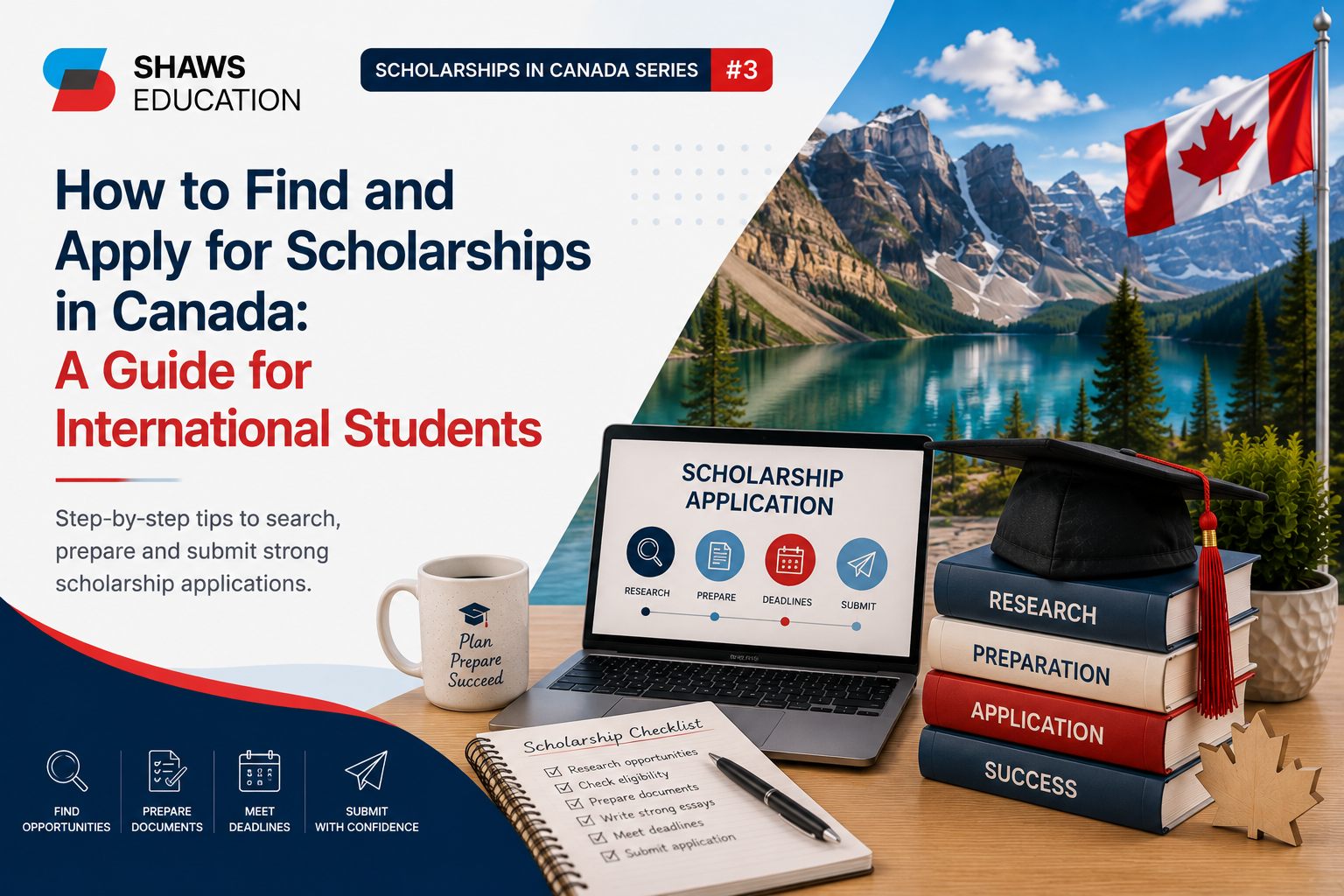
Scholarships in Canada Series #3
Finding a scholarship is only the first step.
For international students planning to study in Canada, the scholarship process can involve different eligibility requirements, deadlines, supporting documents and application procedures. Some scholarships are automatically considered with an admission application, while others require a separate application or even nomination by a school or institution.
A successful scholarship search therefore requires more than simply finding an award with an attractive value.
In Part 3 of Shaws Education’s Scholarships in Canada Series, we walk through a practical step-by-step approach to finding, evaluating and applying for scholarship opportunities in Canada.
Step 1: Start Your Scholarship Search Early
Scholarship planning should ideally begin at the same time as your school and program research.
Why?
Because scholarship deadlines do not always match admission deadlines.
Some major entrance awards may close earlier than regular university applications, while other scholarships require additional documents, references or nominations that take time to arrange.
Starting early gives you more time to:
- Research available opportunities
- Compare eligibility requirements
- Prepare supporting documents
- Request recommendation letters
- Write and revise scholarship essays
- Coordinate with schools or institutions when required
- Submit applications before the deadline
Do not wait until you receive an admission offer before beginning your scholarship search.
By then, some opportunities may already have closed.
Step 2: Search in More Than One Place
There is no single database containing every scholarship available to international students in Canada.
A strong scholarship search should include several sources.
Government of Canada – EduCanada
EduCanada provides an official scholarship search tool for international students, researchers and post-secondary institutions.
Students can search for opportunities based on factors such as:
- Citizenship
- Applicant profile
- Country or territory
This is an excellent starting point for identifying Government of Canada and other international scholarship opportunities.
Canadian Universities and Colleges
If you are applying for a full degree, diploma or other academic credential, always check the scholarship and financial-aid section of each institution you are considering.
Look for terms such as:
- International Student Scholarships
- Entrance Awards
- International Entrance Scholarships
- Merit Awards
- Financial Aid
- Awards and Bursaries
- Faculty Scholarships
- Graduate Funding
As discussed in Part 2 of this series, some institutional scholarships are automatic, while others require separate applications.
Your Home Country
Students should also explore scholarship opportunities offered by:
- Government agencies
- Universities
- Foundations
- Professional organizations
- Non-government organizations
- Private scholarship providers
Funding opportunities may exist both in Canada and in your home country.
Step 3: Check Eligibility Before Spending Time on an Application
Before preparing an application, read the eligibility requirements carefully.
Do not assume that a scholarship for “international students” is open to every international applicant.
Eligibility may depend on:
Citizenship or country of residence
Some scholarships are available only to students from specific countries or regions.
Level of study
An award may be limited to undergraduate, master’s, doctoral, research or exchange students.
Field of study
Some scholarships are restricted to particular academic disciplines.
Academic achievement
Minimum grades or other academic requirements may apply.
Admission status
Some awards require applicants to have already applied for or received admission.
Financial need
Certain awards consider the applicant’s financial circumstances.
Leadership and extracurricular involvement
Scholarships may also evaluate community service, leadership, volunteering, entrepreneurship or other accomplishments.
Language requirements
Language requirements can vary by scholarship and institution.
A few minutes spent checking eligibility carefully can save hours preparing an application for an award you cannot receive.
Step 4: Understand Who Actually Submits the Application
This is one of the most commonly misunderstood parts of the scholarship process.
Not every international scholarship allows the student to apply directly.
Depending on the program, there may be several application models.
Automatic Consideration
You submit your admission application and eligible applicants are automatically considered for the scholarship.
Separate Student Application
You must complete an additional scholarship application, often including essays, references or supporting documents.
Nomination
Your current school, prospective institution or another authorized organization may need to nominate you.
Institution Applies on Your Behalf
For certain Government of Canada scholarship programs, the Canadian host institution is responsible for submitting the application or nomination.
Before beginning an application, always ask:
Who actually submits this scholarship application?
Understanding this early can prevent missed deadlines and unnecessary work.
Step 5: Create a Scholarship Tracker
Once you begin identifying opportunities, it can become difficult to remember every requirement and deadline.
Create a simple spreadsheet or scholarship tracker.
For each opportunity, record:
- Scholarship name
- Institution or organization
- Scholarship value
- Eligibility
- Application method
- Admission deadline
- Scholarship deadline
- Required documents
- Recommendation letters
- Essay or personal statement requirements
- Nomination requirements
- Renewable or one-time award
- Renewal conditions
- Application status
You can also categorize opportunities as:
High Priority – Strong match with your profile
Possible – Eligible, but highly competitive or less closely matched
Automatic – No separate scholarship application required
This makes the process much easier to manage.
Step 6: Prepare Your Supporting Documents Early
Scholarship applications may require supporting documents beyond the standard university admission package.
Depending on the award, these may include:
- Academic transcripts
- Proof of enrolment
- Curriculum vitae or résumé
- Personal statement
- Scholarship essay
- Reference or recommendation letters
- Leadership or extracurricular activity records
- Research proposal
- Proof of financial need
- Language test results
- Other program-specific documentation
Do not leave these until the final few days.
Recommendation letters, official academic documents and institutional approvals can take time to obtain.
Step 7: Write a Strong Scholarship Statement
When a scholarship requires an essay or personal statement, avoid simply repeating your résumé.
A strong scholarship statement should help the selection committee understand:
Who are you?
Explain your academic interests, experiences and motivation.
What have you achieved?
Use specific examples rather than general statements.
Why does this program make sense for you?
Connect your previous experience with your proposed studies.
What impact have you made?
Leadership does not necessarily mean holding a formal title. Community involvement, volunteering, mentoring, projects and initiatives can all demonstrate impact.
What do you plan to do next?
Explain how your Canadian education connects to your future academic, professional or community goals.
Most importantly, tailor your statement to the specific scholarship.
A generic essay submitted to multiple competitions is usually less effective than an application that clearly responds to the award’s objectives and selection criteria.
Step 8: Choose Your References Carefully
If recommendation letters are required, select referees who genuinely know your academic performance, professional experience, leadership or character.
A strong reference should be able to provide specific examples of your abilities and achievements.
Depending on the scholarship, suitable referees might include:
- Teachers or professors
- Academic supervisors
- Employers
- Research supervisors
- Community leaders
- Program coordinators
Give your referee enough time.
Provide them with information about the scholarship, your study plans, your achievements and the submission deadline.
A last-minute request rarely produces the strongest recommendation.
Step 9: Pay Close Attention to Deadlines
Scholarship deadlines should be treated separately from admission deadlines.
For every opportunity, confirm:
- Deadline date
- Time zone
- Whether documents must be received or merely submitted by that date
- Whether references have a separate deadline
- Whether nomination is required before the application
- Whether the institution has an earlier internal deadline
Whenever possible, aim to complete your application several days before the official deadline.
This gives you time to resolve technical issues, missing documents or unexpected questions.
Step 10: Review Everything Before You Submit
Before submitting, conduct a final application review.
Ask yourself:
Eligibility
Do I meet every mandatory requirement?
Documents
Have I uploaded every required document in the correct format?
Essay
Does my statement answer the actual question?
Accuracy
Are names, dates, grades and other details correct?
References
Have my referees completed their requirements?
Deadline
Am I submitting before the correct deadline and time zone?
Instructions
Have I followed all application guidelines?
A strong application can still be unsuccessful if it is incomplete or submitted incorrectly.
Common Scholarship Mistakes to Avoid
International students should be especially careful to avoid several common mistakes:
Starting too late
Major awards may have early deadlines.
Applying without checking eligibility
Not every international scholarship is open to every nationality or study level.
Assuming every scholarship is applied for directly
Some awards require institutional nomination or submission.
Using the same essay for every scholarship
Applications should reflect the specific award criteria.
Focusing only on the largest scholarships
Smaller awards can still significantly reduce education costs.
Ignoring renewable conditions
A renewable award may require a certain academic standing or other conditions.
Submitting incomplete documents
Missing information can result in an application not being considered.
Build a Scholarship Strategy — Not Just a Scholarship List
The goal should not simply be to apply for as many scholarships as possible.
A better approach is to identify opportunities that genuinely match your:
- Academic profile
- Citizenship
- Study level
- Program
- Achievements
- Leadership experience
- Financial circumstances
- Future goals
Then prioritize the strongest matches.
Scholarship planning should also be considered alongside admission strategy, tuition, living costs and overall education planning.
At Shaws Education, we help international students explore Canadian institutions and programs, understand admission requirements and identify potential scholarship and entrance-award opportunities as part of the overall application strategy.
Ready to Start Your Canadian Education Journey?
A well-planned application strategy can help you identify the right programs, understand available funding opportunities and avoid missing important deadlines.
Contact Shaws Education to explore Canadian study options and build an education and scholarship strategy based on your academic background and goals.
Official Resources
Students should always verify current scholarship requirements, deadlines and application procedures directly with the scholarship provider or educational institution.
Recommended official resources include:
- EduCanada – Scholarships for International Applicants
- EduCanada – Search for Scholarships
- EduCanada – Apply for Scholarships
- EduCanada – Frequently Asked Questions About Scholarships for International Applicants
- Scholarship and financial-aid pages of individual Canadian universities and colleges
This article is intended for general educational information. Scholarship availability, eligibility and selection decisions are determined by individual institutions and scholarship providers. Shaws Education does not guarantee admission, scholarship eligibility or funding.
Scholarships in Canada Series
This is Part 3 of Shaws Education’s Scholarships in Canada Series.
Part 1
Scholarships for International Students in Canada: What You Need to Know
Part 2
University Scholarships in Canada for International Students: Where to Look
Part 3
How to Find and Apply for Scholarships in Canada: A Guide for International Students